Anatomy of a losing day: June 5, 2026
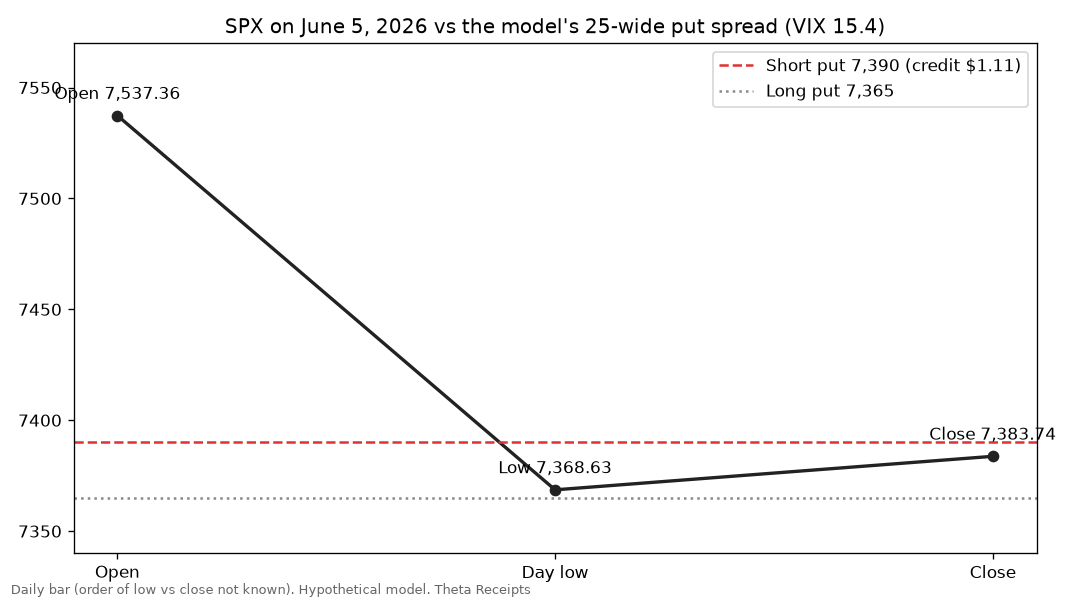
The model sold a ~5.7-delta put spread. SPX closed below the short strike anyway.
Hypothetical backtest. SPX 0DTE 25-wide put credit spread, 1 contract, Jan 2015 – Oct 12 2026 (2,960 trading days). Black-Scholes model prices from daily ^GSPC + ^VIX bars, put IV = VIX × 1.25, $0.65/leg fees, $0.15 slippage on stop exits. Daily bars: any touch of the stop counts as a stop, no gaps, no intraday path. Use for relative comparison only, not expected P&L.
The day, from the backtest file
| Item | Value |
|---|---|
| SPX open | 7,537.36 |
| VIX | 15.4 |
| Spread | Short 7,390 / long 7,365 put |
| Credit | $1.11 |
| Short put delta | ~5.7 |
| SPX day low | 7,368.63 |
| SPX close | 7,383.74 (below the short strike) |
| 2× stop | Fired |
| Model result | −$128.92 |
The lesson
- “Far out of the money” isn’t “safe.” A 5–6 delta put still finishes in the money some days.
- With the stop, the loss was about one average winning day (avg win 113).
- Without a stop, a close between the strikes is the kind of day behind the no-stop worst-day column (−$2,396 worst over 2,960 days).
- In our iron condor test the call side wasn’t stopped that day. Both sides were stopped on the same day only 16 times in 2,960 days. A full IC study is coming.
Get one study a week
Plain-English backtests. No signals, no hype. Free rule card when you join.
Opens our Beehiiv signup page to confirm. Or subscribe free on Beehiiv. Unsubscribe anytime.